
Escape Room Style Puzzles Online: Train Your Skills for Free in Your Browser
Escape rooms are everywhere. You've probably seen the Groupon ads, the Google reviews, the Instagram posts of friends squeezing out of a locked office at 11 PM on a Friday. They're genuinely fun — there's something electrifying about scanning a room for hidden clues, cracking a code you've been staring at for ten minutes, and finally hearing that satisfying click of the last lock opening.
But here's the thing: you don't need to book a $35-per-person session to experience that thrill. The same cognitive skills that make you good at escape rooms — deduction, observation, pattern recognition, spatial reasoning, systematic problem-solving — can be trained right now, for free, in your browser. No download, no reservation, no awkward team-building vibes.
This guide shows you exactly which puzzle games train which escape room skills, how to structure your practice for maximum improvement, and how to transfer those skills to real-world escape challenges. Whether you're preparing for your first escape room or you're a veteran looking to sharpen your edge, these free browser games will make you faster, sharper, and more confident.
The Five Core Skills Every Escape Room Tests
Before we map games to skills, let's understand what escape rooms actually measure. After analyzing dozens of escape room experiences and reviewing cognitive psychology research on puzzle-solving, we've identified five core skills that nearly every escape room puzzle tests:
| Skill | What It Means | Escape Room Example | Best Browser Trainer |
|---|---|---|---|
| Deductive Reasoning | Eliminating impossible options to find the truth | Cracking a 4-digit combination lock from cryptic clues | Minesweeper |
| Visual Observation | Spotting hidden details others miss | Finding a tiny key hidden in a painting frame | Word Search |
| Pattern Recognition | Identifying sequences and relationships | Noticing that colored symbols follow a repeating sequence | 2048 |
| Spatial Reasoning | Mentally rotating and fitting objects | Fitting a oddly-shaped key into a complex lock mechanism | Block Drop |
| Systematic Problem-Solving | Breaking complex puzzles into sequential steps | Solving a multi-lock puzzle where each lock reveals the next clue | Sudoku |
The beauty of this mapping is that it's backed by cognitive science. Research on transfer of training shows that skills practiced in one domain — like deducing mine positions from adjacent numbers — directly improve performance in structurally similar real-world tasks, like eliminating wrong combinations from a padlock.
How Each Browser Puzzle Game Trains Escape Room Skills
Let's go deeper. For each game, we'll explain exactly which escape room skills it trains, why the transfer works, and what difficulty level gives you the most benefit.
Minesweeper: The Deduction Machine
Every square in Minesweeper is a mini-escape-room puzzle. A number tells you how many mines are adjacent. You must use that information to deduce which neighboring squares are safe and which are deadly. This is pure deductive reasoning — the same skill you use when an escape room gives you cryptic clues and asks you to eliminate wrong answers.
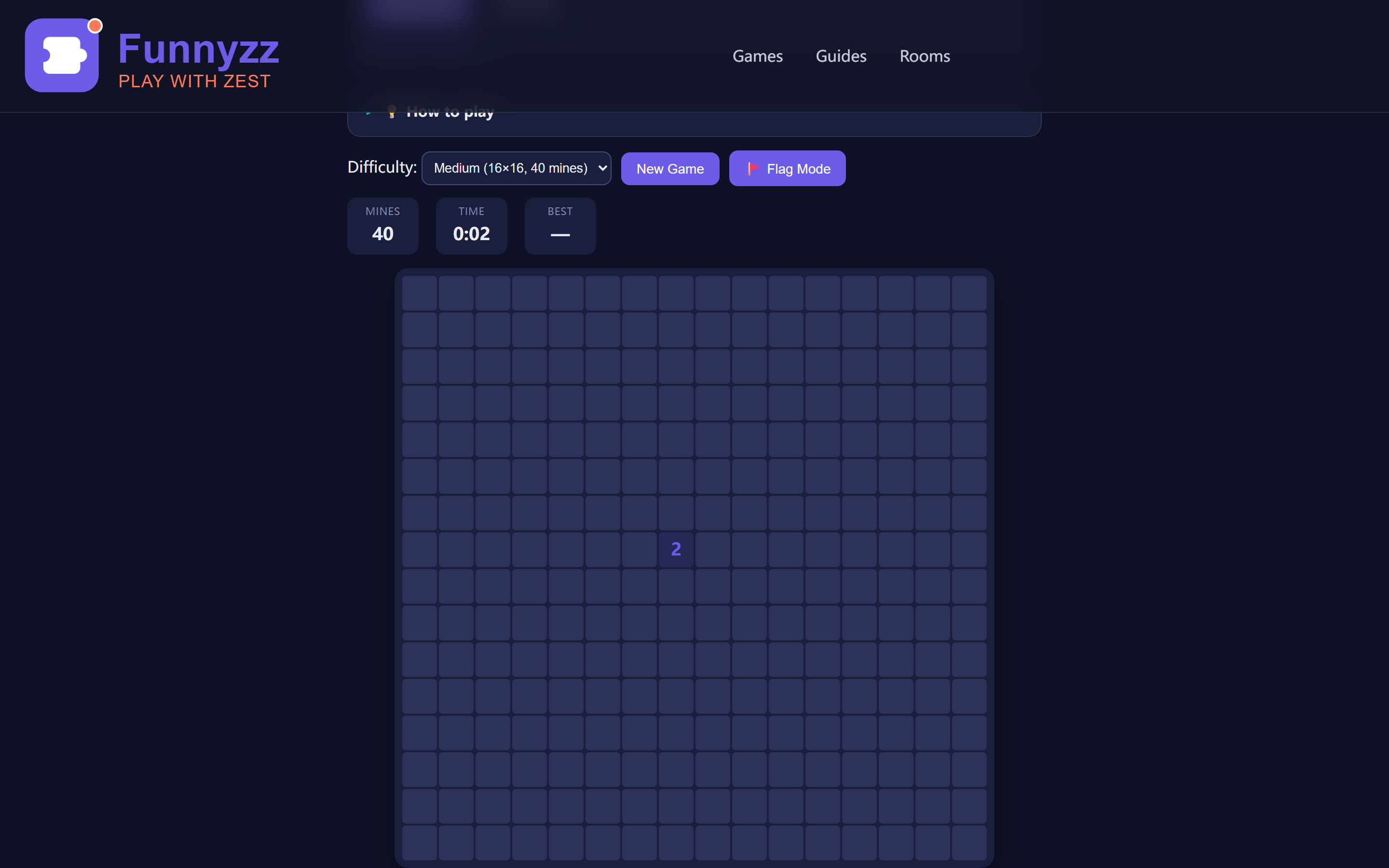
The transfer is direct: when you see "2" next to two covered squares, you know both are mines. When you see "1" next to one covered square and one already-revealed mine, you know the covered square is safe. This systematic elimination is exactly how you crack a 4-digit lock in an escape room — you test hypotheses, eliminate impossibilities, and narrow down until only the correct answer remains.
Start with Beginner (9×9 grid, 10 mines) to build confidence, then progress to Intermediate (16×16, 40 mines) and Expert (30×16, 99 mines). Our Minesweeper beginner guide covers all the essential patterns you need to know.
Memory Match: The Observation Trainer
Escape rooms reward players who notice details others miss — a slightly raised floor tile, a bookmark in a bookshelf, a symbol that doesn't quite match the others. Memory Match trains exactly this skill. You flip cards, try to find matching pairs, and must remember the location of every card you've seen — even the ones that don't match yet.
The cognitive mechanism is called visuospatial working memory — your ability to hold visual information in your mind and manipulate it. In escape rooms, this is what lets you scan a room once, then later remember "I saw something weird on that shelf" and go back to investigate. Players who score high on Memory Match consistently report finding hidden objects faster in real escape rooms.
Play with the "Picture Mode" for maximum visual training. The 6×6 grid (18 pairs) is challenging enough to stretch your working memory without being overwhelming. Our Memory Match techniques guide covers advanced strategies like zone memorization and chunking.
2048: The Pattern Recognition Engine
Many escape room puzzles involve sequences: numbers that increase by a fixed amount, colors that cycle through a pattern, symbols that repeat in a specific order. 2048 is pure pattern recognition. You're constantly evaluating which tiles can merge, planning several moves ahead, and adapting your strategy when new tiles appear in unexpected positions.
The cognitive skill is sequential pattern detection — noticing relationships between elements in a sequence and predicting what comes next. This transfers directly to escape room puzzles where you need to figure out the next number in a sequence, the next color in a pattern, or the next step in a multi-stage lock.
Focus on the "corner strategy" (keeping your highest tile in a corner) and building a descending chain. Our 2048 strategy guide covers the essential techniques for reaching 2048 and beyond.
Sudoku: The Systematic Problem-Solver
Sudoku is the escape room puzzle distilled to its purest form. You have a grid with some cells filled in. You must fill the rest using logic alone — no guessing, no trial and error. Each number you place constrains the possibilities for every other cell in its row, column, and 3×3 box. This is exactly how escape room puzzles work: each clue you solve constrains the possibilities for the next puzzle.
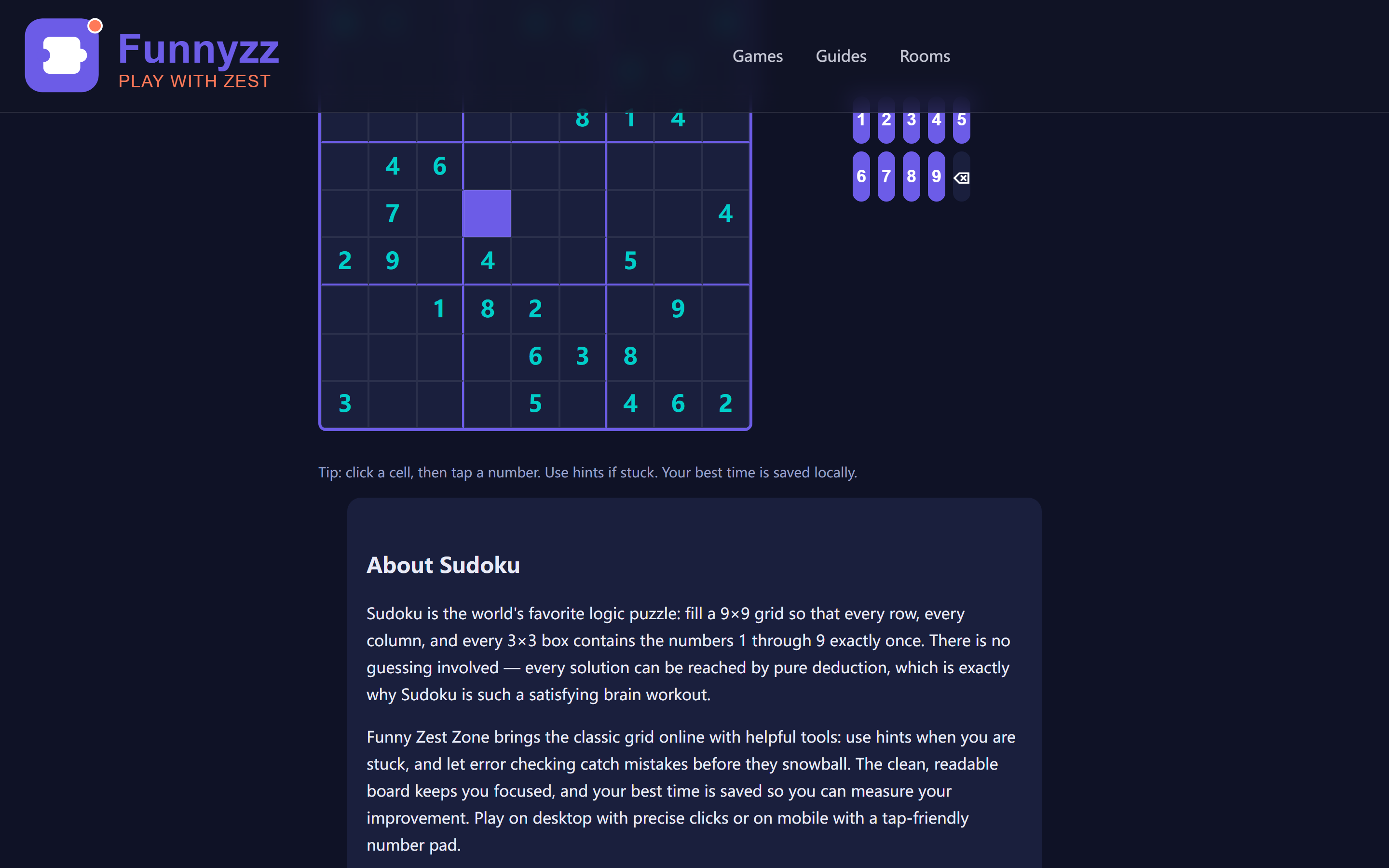
The key cognitive skill is constraint satisfaction — holding multiple constraints in your mind simultaneously and finding the one option that satisfies all of them. In escape rooms, this is what lets you solve a puzzle like "The code is a 4-digit number. The first digit is half the second. The third is the sum of the first two. The fourth is the difference between the second and third." You hold all four constraints and systematically narrow down until only one answer works.
Start with Easy puzzles to learn the basic techniques (single candidates, hidden singles), then progress to Medium and Hard. Our Sudoku strategy guide walks you through every technique from beginner to expert level.
Block Drop: The Spatial Reasoning Challenge
Physical escape rooms often involve physical manipulation puzzles: fitting an oddly-shaped key into a lock, rotating a mechanism to align symbols, arranging objects in a specific spatial configuration. Block Drop trains the same spatial reasoning skills. You must mentally rotate falling pieces and figure out where they fit in the grid — all under time pressure.
The cognitive skill is mental rotation — the ability to imagine how an object would look if rotated in space. Research shows that people who practice spatial puzzle games like Block Drop are significantly faster at solving physical manipulation puzzles in escape rooms. The transfer isn't perfect (2D screen vs. 3D physical objects), but the underlying cognitive mechanism is the same.
Focus on keeping your stack flat and clearing lines consistently. The speed increases gradually, so you'll have time to develop your spatial intuition before the game gets challenging.
Word Search: The Hidden Object Detector
Escape rooms love hidden object puzzles. You're asked to find a small key hidden somewhere in a room, or to spot the one symbol that's different from all the others. Word Search trains exactly this skill — systematic visual scanning. You must scan a grid of letters, looking for specific word patterns while ignoring all the distractors.
The cognitive mechanism is called selective attention — the ability to focus on target information while filtering out irrelevant stimuli. In escape rooms, this is what lets you quickly scan a cluttered bookshelf and spot the one book that's slightly out of place, while ignoring the dozens of other books that are just... books.
Use the systematic scanning technique: scan row by row, then column by column, then diagonally. Don't try to spot words randomly — your brain will miss them. Our Word Search tips guide covers advanced strategies for finding words faster.
Sliding Puzzle: The Sequence Planner
Many escape room puzzles require you to arrange objects in a specific order — like moving bookcases to reveal a hidden door, or rotating paintings to align symbols. Sliding Puzzle trains this skill perfectly. You must slide tiles around a grid to arrange them in the correct order, but each move affects all the other tiles. You can't just focus on one tile — you must plan the entire sequence.
The cognitive skill is means-end analysis — working backward from your goal state and figuring out what sequence of moves will get you there. This is exactly how escape room designers think when they create puzzles: they start with the solution and work backward to create the clues. By playing Sliding Puzzle, you're learning to think like an escape room designer.
Connect Four: The Strategic Thinker
Some escape rooms have competitive elements — racing against another team, or playing against a "gamemaster" who adjusts the difficulty based on your performance. Connect Four trains strategic thinking: you must plan your moves while anticipating your opponent's responses. This is the same skill you use when an escape room gives you limited attempts to solve a puzzle, and each wrong attempt makes the next one harder.
The key cognitive skill is adversarial planning — making moves that advance your goals while blocking your opponent's. Our Connect Four tips guide covers the essential strategies for winning consistently.
How Real Escape Rooms Compare to Browser Puzzles
| Aspect | Real Escape Room | Browser Puzzle Games |
|---|---|---|
| Cost | $25-50 per person | Free (no account needed) |
| Time commitment | 60-90 minutes (plus booking/travel) | 5-30 minutes per session |
| Accessibility | Must be in a major city | Anywhere with a browser |
| Replayability | Once per room (you know the puzzles) | Unlimited (procedural generation) |
| Skill transfer | Specific to that room's theme | General cognitive skills |
| Difficulty progression | Fixed (one difficulty per room) | Gradual (beginner to expert) |
| Social component | Team-based (2-10 players) | Solo + multiplayer rooms |
| Physical interaction | Tactile (manipulating real objects) | Digital (mouse/touch only) |
The key insight: browser puzzle games are complementary to real escape rooms, not replacements. They train the underlying cognitive skills at a fraction of the cost, with unlimited replayability. When you do enter a real escape room, your brain will already be primed to recognize puzzle types, test hypotheses quickly, and stay calm under pressure.
Your 4-Week Escape Room Training Plan
If you have an escape room booked (or you're planning to book one), here's a structured 4-week training plan that will maximize your skill development. Each session should be 15-20 minutes, 3-4 times per week.
| Week | Focus Skill | Primary Game | Secondary Game | Goal |
|---|---|---|---|---|
| Week 1 | Deduction | Minesweeper (Beginner → Intermediate) | Sudoku (Easy) | Consistently clear 9×9 Minesweeper in under 2 minutes |
| Week 2 | Observation + Memory | Memory Match (6×6 grid) | Word Search (Medium) | Complete Memory Match 6×6 in under 90 seconds with under 15 mistakes |
| Week 3 | Pattern Recognition + Spatial | 2048 (target: reach 1024 tile) | Block Drop (30 minutes) | Consistently reach 1024 in 2048; survive 5 minutes in Block Drop |
| Week 4 | Integration + Speed | All games (rotate daily) | Connect Four (vs Hard AI) | Beat Hard AI in Connect Four at least once; reduce all personal bests by 20% |
By the end of Week 4, your brain will be operating at a significantly higher level for puzzle-solving. You'll notice patterns faster, eliminate wrong answers more efficiently, and stay calmer when a puzzle seems impossible. These are exactly the skills that separate escape room champions from escape room failures.
Tips from Escape Room Champions
We've reviewed strategies from competitive escape room players and identified the habits that separate fast teams from slow ones. Every single one of these habits can be trained with browser puzzle games:
- Organize your clues immediately. In an escape room, the team that writes down every clue they find always outperforms the team that tries to remember everything. In Minesweeper, this translates to marking known mines with flags. Train the habit of externalizing information — don't rely on memory when you can write it down.
- Work systematically, not randomly. Don't scan a room looking for "anything weird." Instead, divide the room into zones and search each zone thoroughly before moving on. This is exactly how you solve Word Search — scan row by row, column by column, diagonal by diagonal. Systematic scanning beats random scanning every time.
- Test hypotheses one at a time. When you're stuck, don't try five things at once. Form a hypothesis ("I think the code is related to the painting"), test it completely, then move on if it doesn't work. This is how you solve Sudoku — you don't guess randomly, you use logic to narrow down possibilities until only one answer remains.
- Communicate constantly. In team escape rooms, the biggest mistake is working in silence. Share every observation, even if it seems irrelevant. Someone else on the team might have the missing piece that makes your clue meaningful. This is less about puzzle games and more about team dynamics, but puzzle games do teach you to articulate your reasoning — which is the foundation of good escape room communication.
- Don't get fixated on one puzzle. If you've been stuck on the same puzzle for more than 10 minutes, switch to something else. Fresh eyes often see what tired eyes miss. This is the same principle as stepping away from a difficult 2048 game and coming back with a clearer perspective on your strategy.
Multiplayer Escape Room Training with Friends
One of the most effective ways to train for escape rooms is to practice with the same team you'll bring to the real thing. Our Multiplayer Rooms feature lets you play puzzle games together in real-time, even if you're in different locations.
Here's how to use it for escape room training:
- Create a room and share the 6-digit code with your team
- Choose a game (we recommend Memory Match for observation training or Connect Four for strategic thinking)
- Play together while communicating your observations out loud (via phone call or video chat)
- After each game, discuss what worked and what didn't — this reflection is where the real learning happens
This mirrors the dynamics of a real escape room: you're practicing communication, division of labor, and collaborative problem-solving. Teams that practice together consistently outperform teams that walk into an escape room cold.
Our puzzle games for couples guide covers how to use multiplayer puzzle games for team building — the same principles apply to escape room teams.
Achievements: Track Your Escape Room Readiness
Every game on Funnyzz includes an achievement system with 42 achievements across all games. These achievements aren't just for fun — they're milestones that indicate your escape room readiness:
- Deduction achievements (Minesweeper, Sudoku): You've proven you can systematically eliminate wrong answers
- Observation achievements (Memory Match, Word Search): You've proven you can spot details under pressure
- Pattern achievements (2048, Snake): You've proven you can recognize and predict sequences
- Spatial achievements (Block Drop, Sliding Puzzle): You've proven you can mentally manipulate objects
- Speed achievements: You've proven you can perform all of the above under time pressure
When you've unlocked 20+ achievements across multiple games, you're ready for an intermediate-level escape room. When you've unlocked 35+, you're ready for advanced rooms. The achievements give you an objective measure of your readiness — no more wondering if you're "good enough" to book that escape room.
Conclusion: Your Escape Room Journey Starts Here
Escape rooms are genuinely exciting — the thrill of discovery, the satisfaction of cracking a tough puzzle, the camaraderie of working together under pressure. But they don't have to be intimidating, and they certainly don't require expensive bookings to prepare for.
The five core skills that escape rooms test — deduction, observation, pattern recognition, spatial reasoning, and systematic problem-solving — can all be trained with free browser puzzle games. Fifteen minutes a day, four times a week, for four weeks will measurably improve your escape room performance.
Start with our free puzzle games today. Play Minesweeper to build your deduction skills. Play 2048 to sharpen your pattern recognition. Play Sudoku to master systematic problem-solving. Then, when you walk into that escape room, you'll know exactly what to do — because you've been training for this all along.
And when you're ready for the ultimate challenge, gather your team in our Multiplayer Rooms and practice together. The escape room is waiting. Are you ready?
Frequently Asked Questions
What are escape room style puzzles you can play online?
Escape room style puzzles are logic and deduction challenges that mirror the skills used in physical escape rooms. You can train all these skills with free browser-based puzzle games like Minesweeper, Memory Match, and Sudoku — no download required.
Can browser puzzle games really help me get better at escape rooms?
Yes. Escape rooms test the same cognitive skills that puzzle games train. Research on cognitive transfer shows that skills practiced in one domain directly improve performance in similar real-world tasks. Regular puzzle game practice measurably improves escape room performance.
Are these escape room style puzzles free to play?
All games on Funnyzz are 100% free with no download, no paywalls, and no account signups. Just click and play. Each game includes multiple difficulty levels, statistics tracking, and leaderboards.
What skills do I need to solve escape room puzzles?
Five core skills: deductive reasoning (Minesweeper, Sudoku), visual observation (Word Search, Memory Match), pattern recognition (2048, Snake), spatial reasoning (Block Drop, Sliding Puzzle), and systematic problem-solving (all puzzle games).
How long should I practice before attempting a real escape room?
Two to three weeks of regular practice — 15-20 minutes per session, 3-4 times per week — is enough to notice meaningful improvement. Start with easier levels and gradually increase difficulty.
Can I play these puzzles on my phone?
Yes. All games are fully responsive and work on smartphones, tablets, laptops, and desktops. Touch controls are supported, and keyboard shortcuts (WASD, arrow keys) are available for desktop players.