
Logic Puzzles for Critical Thinking: Train Your Brain to Solve Anything
Master deductive reasoning, pattern recognition, and systematic problem-solving through classic logic puzzles
Why Logic Puzzles Matter for Critical Thinking
Critical thinking isn't just an academic concept—it's the ability to analyze information objectively, identify patterns, evaluate evidence, and make reasoned decisions. Logic puzzles are among the most effective tools for developing these skills because they force you to practice structured thinking in a low-stakes, engaging environment.
Unlike passive activities like watching videos or reading articles, logic puzzles require active engagement. You must analyze constraints, test hypotheses, eliminate impossible options, and draw conclusions based on available evidence. These are the exact same cognitive processes used in scientific research, legal analysis, software debugging, financial modeling, and countless other professional fields.
Research in cognitive psychology shows that regular practice with logic puzzles strengthens working memory, improves attention to detail, enhances pattern recognition, and develops the ability to think several steps ahead. These skills transfer beyond the puzzle itself, helping you approach real-world problems with greater clarity and confidence.
| Cognitive Skill | How Logic Puzzles Develop It | Real-World Application |
|---|---|---|
| Deductive Reasoning | Eliminating impossible options based on constraints | Diagnosing problems, debugging code, legal analysis |
| Pattern Recognition | Identifying relationships and sequences | Data analysis, market trends, scientific research |
| Working Memory | Tracking multiple constraints simultaneously | Project management, complex decision making |
| Spatial Reasoning | Visualizing relationships in 2D/3D space | Architecture, engineering, navigation |
| Sequential Thinking | Planning moves several steps ahead | Strategic planning, chess, game theory |
The Best Logic Puzzles for Building Critical Thinking
Not all logic puzzles are created equal. Different puzzle types develop different cognitive skills, and a well-rounded training regimen should include variety. Here are the most effective logic puzzles for building critical thinking, ranked by the specific skills they develop.
1. Sudoku: The Foundation of Deductive Reasoning
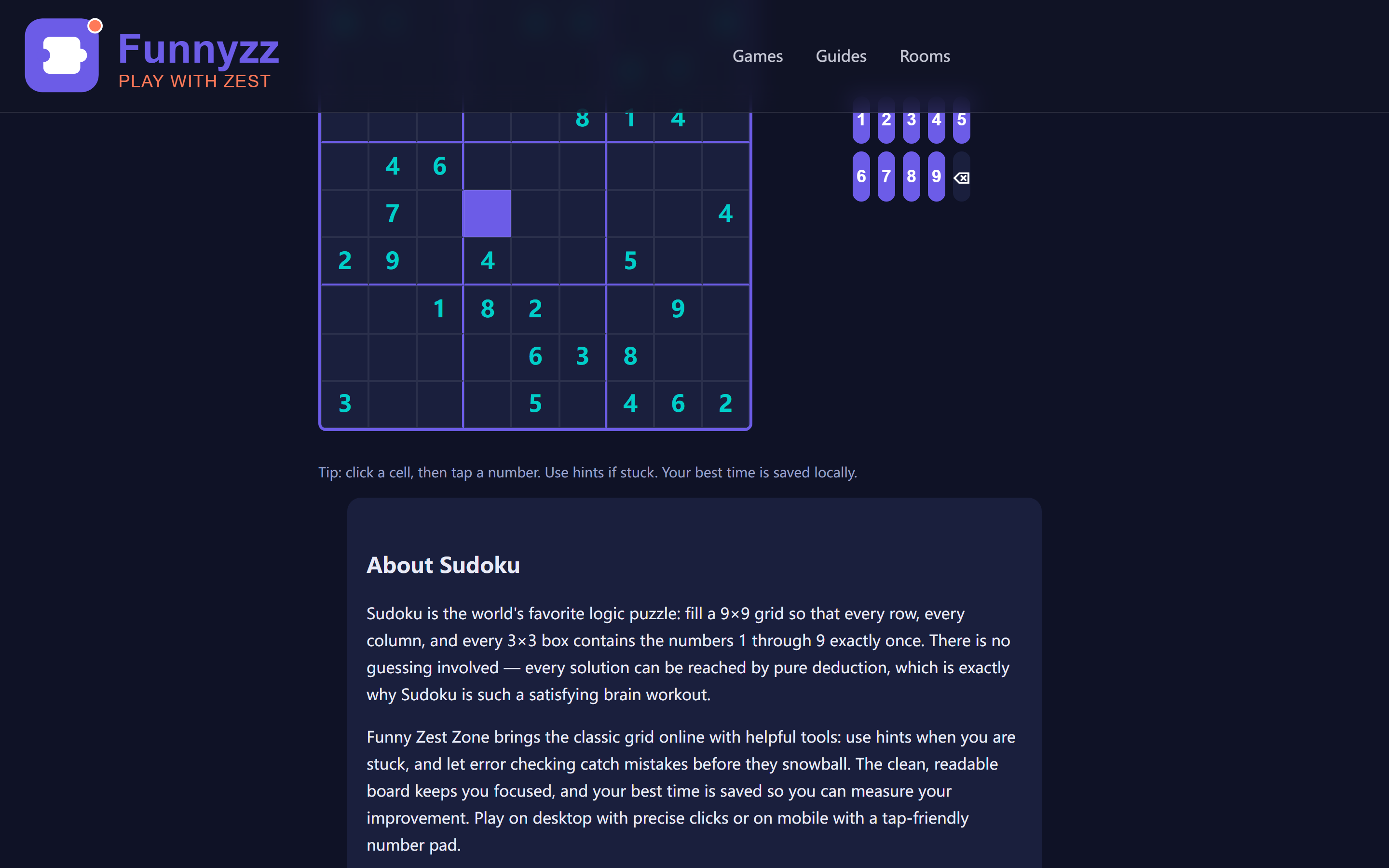
Sudoku is perhaps the most widely recognized logic puzzle, and for good reason. The rules are simple: fill a 9×9 grid so that each row, column, and 3×3 box contains the digits 1-9 exactly once. But beneath this simplicity lies deep strategic complexity.
Sudoku teaches deductive reasoning—the process of eliminating impossible options until only the correct answer remains. You learn to scan for "naked singles" (cells with only one possible value), "hidden singles" (values that can only go in one place within a row, column, or box), and more advanced patterns like "naked pairs" and "pointing pairs."
The beauty of Sudoku is that it requires no mathematical knowledge—only logical reasoning. You're not calculating; you're deducing. This makes it accessible to anyone while still providing a significant cognitive challenge at higher difficulty levels.
Skills developed: Deductive reasoning, pattern recognition, attention to detail, systematic elimination
2. Minesweeper: Probabilistic Thinking Under Uncertainty
Minesweeper adds a layer of probabilistic reasoning to pure logic. You must deduce mine locations based on numbered clues, but sometimes you'll encounter situations where logic alone can't determine the answer—you must make educated guesses based on probability.
This teaches probabilistic thinking—the ability to make decisions when you don't have complete information. You learn to calculate odds, assess risk, and make the best possible choice given the available evidence. These skills are crucial in fields like finance, medicine, and strategic planning, where decisions must often be made with incomplete data.
Minesweeper also develops spatial reasoning and the ability to visualize relationships between adjacent cells. You must think in two dimensions, understanding how each cell's status affects its neighbors.
Skills developed: Probabilistic reasoning, spatial visualization, risk assessment, decision-making under uncertainty
3. Ultimate Tic-Tac-Toe: Strategic Thinking and Long-Term Planning
Ultimate Tic-Tac-Toe takes the simple game of tic-tac-toe and adds layers of strategic depth. You play on nine boards simultaneously, and each move you make determines which board your opponent must play in next.
This puzzle teaches strategic thinking—the ability to plan several moves ahead and anticipate your opponent's responses. You must balance short-term gains (winning a local board) with long-term strategy (controlling the global board). Sometimes you'll sacrifice a local board to gain a strategic advantage elsewhere.
Ultimate Tic-Tac-Toe also develops adaptability—the ability to adjust your strategy based on your opponent's moves. You can't follow a fixed plan; you must respond dynamically to changing conditions.
Skills developed: Strategic planning, anticipation, adaptability, multi-level thinking
4. Sliding Puzzles: Sequential Problem Solving
Sliding puzzles require you to rearrange tiles by sliding them into an empty space. The challenge isn't just reaching the solution—it's finding the most efficient sequence of moves.
These puzzles develop sequential thinking—the ability to plan a series of steps in the correct order. You must think ahead, understanding that each move constrains your future options. This is similar to solving a Rubik's Cube or planning a sequence of actions in project management.
Sliding puzzles also teach patience and persistence. Some puzzles require dozens of moves to solve, and rushing often leads to mistakes. You learn to work methodically, checking each step before proceeding.
Skills developed: Sequential planning, foresight, patience, systematic execution
5. Connect Four: Competitive Logic and Game Theory
Connect Four introduces competitive elements to logic puzzles. You're not just solving a puzzle—you're competing against an opponent who's trying to thwart your plans.
This develops competitive logic—the ability to think about your opponent's perspective while pursuing your own goals. You must balance offense (building your own four-in-a-row) with defense (blocking your opponent's threats). This is similar to negotiation, debate, or any competitive situation.
Connect Four also introduces basic game theory concepts like forced moves, zugzwang (being forced to make a move that worsens your position), and the importance of controlling key squares.
Skills developed: Competitive strategy, opponent modeling, game theory, tactical thinking
How to Practice Logic Puzzles Effectively
Simply playing logic puzzles isn't enough to maximize cognitive benefits. You need to practice deliberately—with intention, focus, and reflection. Here's how to structure your practice for maximum benefit.
Start with the Right Difficulty Level
Choose puzzles that challenge you but aren't overwhelming. If you're solving puzzles easily with no mistakes, increase the difficulty. If you're stuck constantly and feeling frustrated, decrease the difficulty. The optimal challenge level is where you're solving puzzles correctly about 70-80% of the time.
For Sudoku, start with "Easy" difficulty and work your way up through "Medium," "Hard," and "Expert" as your skills improve. For Minesweeper, begin with beginner difficulty (fewer mines) before progressing to intermediate and expert levels.
Focus on Process, Not Just Results
Don't just try to solve the puzzle—pay attention to how you solve it. Ask yourself:
- What strategy am I using?
- Why did I make that move?
- Could I have solved it more efficiently?
- What pattern did I recognize (or miss)?
This metacognitive reflection strengthens the learning process and helps you internalize effective problem-solving strategies.
Mix Different Puzzle Types
Variety is crucial for comprehensive cognitive development. Different puzzles develop different skills, and rotating between them prevents your brain from becoming too specialized.
A good weekly practice routine might include:
- Monday/Wednesday/Friday: Sudoku (deductive reasoning)
- Tuesday/Thursday: Minesweeper (probabilistic thinking)
- Saturday: Ultimate Tic-Tac-Toe or Connect Four (strategic thinking)
- Sunday: Sliding puzzles or 2048 (sequential planning)
Practice Consistently, Not Intensively
Fifteen to thirty minutes of daily practice is more effective than occasional marathon sessions. Consistency builds neural pathways more effectively than intensity. Think of it like physical exercise: regular moderate exercise is better for long-term health than occasional intense workouts.
Set aside a specific time each day for puzzle practice—perhaps during your morning coffee, lunch break, or evening relaxation time. The routine itself becomes a cue that triggers focused thinking.
Track Your Progress
Many puzzle games, including those on Funnyzz, include statistics panels that track your performance over time. Use these to monitor your improvement and stay motivated.
For example, our Sudoku game tracks games played, solve rate, and average time. Our Minesweeper game tracks best times and win rate. Watching these metrics improve over weeks and months provides concrete evidence of your cognitive development.
| Week | Practice Focus | Expected Improvement |
|---|---|---|
| Week 1-2 | Learn basic patterns and rules | Understanding puzzle mechanics |
| Week 3-4 | Recognize common patterns quickly | Faster solving, fewer mistakes |
| Week 5-8 | Develop strategic approaches | Improved efficiency, better planning |
| Week 9-12 | Master advanced techniques | Significant skill increase, tackle harder puzzles |
| Week 13+ | Continuous improvement and variety | Maintained sharpness, transfer to real-world problems |
Real-World Applications of Logic Puzzle Skills
The skills you develop through logic puzzles don't stay confined to the puzzle board. They transfer directly to professional, academic, and personal contexts.
Professional Applications
Software Development: Debugging code requires the same deductive reasoning used in logic puzzles. You identify symptoms (error messages), form hypotheses about causes, test those hypotheses, and eliminate possibilities until you find the bug. Programmers who regularly solve logic puzzles often report improved debugging skills.
Data Analysis: Analyzing data sets involves identifying patterns, recognizing outliers, and drawing conclusions from incomplete information—the same skills used in solving Minesweeper or complex Sudoku puzzles.
Project Management: Planning a project requires sequential thinking, anticipating obstacles, and adjusting plans based on changing conditions. These are the same skills developed through sliding puzzles and Ultimate Tic-Tac-Toe.
Consulting and Strategy: Management consultants use logic puzzles in interviews specifically because they test the analytical skills needed for the job. Breaking down complex problems, identifying key constraints, and developing structured solutions are core consulting competencies.
Academic Applications
Mathematics: While logic puzzles aren't math problems, they develop the logical reasoning skills that underpin mathematical thinking. Students who regularly solve logic puzzles often find mathematics more intuitive and approachable.
Reading Comprehension: Understanding complex texts requires tracking multiple pieces of information, recognizing relationships, and drawing inferences—all skills strengthened by logic puzzles.
Scientific Reasoning: The scientific method itself is a form of logic puzzle: observe phenomena, form hypotheses, design experiments to test those hypotheses, and draw conclusions based on evidence.
Personal Decision Making
Beyond professional and academic contexts, logic puzzle skills help with everyday decisions:
- Financial decisions: Evaluating investment options, comparing products, budgeting
- Problem solving: Diagnosing car trouble, planning home repairs, organizing events
- Critical consumption: Evaluating news sources, recognizing logical fallacies in arguments
- Planning: Organizing schedules, coordinating logistics, optimizing routes
The ability to think logically and systematically is one of the most transferable skills you can develop, and logic puzzles provide an engaging, accessible way to build that skill.
Common Mistakes to Avoid in Logic Puzzles
Even experienced puzzle solvers make mistakes that limit their cognitive gains. Here are the most common pitfalls and how to avoid them.
Mistake 1: Guessing Instead of Deducting
Logic puzzles should be solved through deduction, not guessing. If you find yourself guessing, the puzzle is probably too difficult for your current skill level. Drop down to an easier difficulty and build your confidence before progressing.
Guessing reinforces bad habits and doesn't strengthen the logical reasoning pathways you're trying to develop. Every move should be based on evidence and reasoning, even if it takes longer to find the solution.
Mistake 2: Not Using Process of Elimination
The process of elimination is the foundation of logic puzzle solving. For every cell, position, or move, ask: "What are all the possibilities? Which ones can I eliminate based on the constraints?"
In Sudoku, for example, before placing a number, check its row, column, and box to eliminate impossible options. In Minesweeper, use the numbered clues to eliminate safe squares and identify likely mine locations.
Mistake 3: Rushing Without Planning
Speed is not the goal—accuracy and logical reasoning are. Rushing leads to mistakes, and mistakes don't build cognitive skills. Take your time, think through each move, and verify your reasoning before proceeding.
As you practice, speed will naturally improve. But prioritizing speed over accuracy in the early stages creates bad habits that are hard to break.
Mistake 4: Sticking to One Puzzle Type
As mentioned earlier, variety is crucial. If you only solve Sudoku, you'll develop strong deductive reasoning but miss out on the probabilistic thinking developed by Minesweeper or the strategic planning developed by Ultimate Tic-Tac-Toe.
Rotate between different puzzle types to ensure comprehensive cognitive development.
Mistake 5: Not Reflecting on Your Process
Simply solving puzzles isn't enough. You need to reflect on how you solved them. What strategies worked? What patterns did you recognize? Where did you get stuck?
This metacognitive reflection strengthens learning and helps you internalize effective problem-solving approaches. After solving a puzzle, take a moment to review your process and identify lessons for next time.
Building a Sustainable Logic Puzzle Practice
The cognitive benefits of logic puzzles come from consistent, long-term practice—not occasional intense sessions. Here's how to build a sustainable practice habit.
Set Realistic Goals
Start with a small, achievable goal: "I'll solve one easy Sudoku puzzle every morning" or "I'll play 15 minutes of logic puzzles during my lunch break." Once that habit is established, you can gradually increase duration or difficulty.
Don't aim for perfection or rapid improvement. Aim for consistency. The goal is to make logic puzzles a regular part of your routine, not a source of stress.
Use Reminders and Cues
Link your puzzle practice to an existing habit. For example:
- After morning coffee → solve one puzzle
- During lunch break → play 15 minutes of puzzles
- Before bed → solve one relaxing puzzle
These cues make it easier to remember and maintain the habit.
Track Your Progress
Many puzzle games track your statistics automatically. Use these metrics to monitor your improvement and stay motivated. Seeing your solve times decrease, your win rate increase, or your difficulty level progress provides concrete evidence of your cognitive development.
You can also keep a simple journal noting which puzzles you solved, how long they took, and what strategies you used. This reflection strengthens learning and provides a record of your progress.
Celebrate Small Wins
Logic puzzle mastery is a long journey. Celebrate small milestones: your first "Hard" Sudoku solve, your first sub-2-minute Minesweeper time, your first Ultimate Tic-Tac-Toe victory against a hard AI.
These celebrations reinforce the habit and keep you motivated for the long term.
Be Patient with Plateaus
Progress isn't always linear. You'll hit plateaus where improvement seems to stall. This is normal. During plateaus, your brain is consolidating skills and preparing for the next level of performance.
During plateaus, try:
- Switching to a different puzzle type
- Reviewing old puzzles to reinforce basics
- Taking a short break (1-2 days) to reset
- Focusing on accuracy rather than speed
Plateaus are temporary. With consistent practice, you'll break through them and continue improving.
Conclusion: Logic Puzzles as Lifelong Cognitive Training
Logic puzzles are more than just entertainment—they're powerful tools for developing critical thinking skills that benefit every area of your life. From deductive reasoning and pattern recognition to strategic planning and probabilistic thinking, these puzzles build the cognitive foundation for success in professional, academic, and personal contexts.
The key is consistent, deliberate practice. Start with puzzles that challenge you but aren't overwhelming. Focus on process, not just results. Mix different puzzle types to develop a well-rounded skill set. And reflect on your progress to reinforce learning.
At Funnyzz, we offer a variety of logic puzzles designed to develop these critical thinking skills. Whether you're a beginner starting with easy Sudoku or an advanced player tackling Ultimate Tic-Tac-Toe, you'll find engaging, challenging puzzles that help you think more clearly and solve problems more effectively.
Start your logic puzzle journey today. Your future self—facing complex decisions, challenging problems, and uncertain situations—will thank you for the cognitive skills you build through regular practice.
Frequently Asked Questions
How do logic puzzles improve critical thinking skills?
Logic puzzles force you to practice deductive reasoning, pattern recognition, and systematic problem-solving. Each puzzle requires analyzing constraints, eliminating impossible options, and making logical deductions—skills that transfer directly to real-world decision making and professional problem solving.
What are the best logic puzzles for beginners?
Beginners should start with simpler versions: easy Sudoku (4x4 or 6x6 grids), basic Minesweeper (beginner difficulty), simple sliding puzzles (3x3 grids), and straightforward pattern recognition games. These teach foundational skills without overwhelming complexity.
How long does it take to see improvement from logic puzzles?
Most people notice initial improvement within 2-3 weeks of daily practice (15-30 minutes per day). Significant skill development typically occurs after 2-3 months of consistent practice. The key is regular, deliberate practice rather than occasional marathon sessions.
Can logic puzzles help with professional skills?
Yes. Logic puzzles develop analytical thinking, systematic problem decomposition, constraint analysis, and decision-making under uncertainty—all highly valued professional skills. Many consulting firms and tech companies use logic puzzles in interviews to assess candidates' analytical abilities.
What is the difference between logic puzzles and math problems?
Logic puzzles focus on reasoning and deduction using given constraints, while math problems often require specific formulas or calculations. Many logic puzzles use numbers but don't require mathematical computation—they test your ability to reason about relationships and eliminate possibilities systematically.
How often should I practice logic puzzles?
For optimal cognitive benefits, practice 15-30 minutes daily. Consistency matters more than duration. Daily practice builds neural pathways more effectively than occasional long sessions. Mix different puzzle types to challenge various cognitive skills and prevent plateau.